Chinese Navy Hints At First Nuclear-Powered Carrier In Video, Expands Build-Up Across Disputed Waters
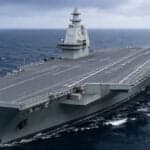


China has hinted at the possible development of a fourth aircraft carrier, which could also become its first nuclear-powered carrier. At the same time, it has called for further development of more than 11,000 islands it claims as its territory.
The video, titled Into the Deep, was released ahead of the 77th anniversary of the Chinese People’s Liberation Army Navy.
It included fictional characters whose names matched, through wordplay, the names of China’s three existing aircraft carriers- Liaoning, Shandong and Fujian.
A new character in the video, a 19-year-old named “Hejian,” led to speculation online that it could be a reference to a nuclear-powered aircraft carrier. His name is a homophone of the Chinese term for “nuclear vessel.”
The timing also gained attention, as China’s current carriers carry sequential pennant numbers 16, 17 and 18, while the character’s age, 19, was seen by some as matching the next possible number in sequence.
China’s defence ministry did not immediately respond to requests for comment on the video.
The country is investing heavily in its navy as part of its long-term goal to build a “bluewater navy” that can operate far from its shores.
This strategy has been in place since 2012, when President Xi Jinping became leader of the ruling Communist Party.
Parts of the video showed military drills and strike scenarios in the Pacific. It also included a scene involving a father and son, where the child named “Xiaowan” is told to return home.
The name is widely seen as an allusion to Taiwan, which China claims as its territory, while Taiwan maintains it is self-governed.
At the same time, China’s Ministry of Natural Resources called for stronger protection and development of more than 11,000 islands it claims.
Image Credits: CGTN
In an article published in the official People’s Daily, the ministry said these islands are important for governance and for accessing deep-sea resources.
It also said major countries are focusing more on ocean development, without naming any specific countries.
The article urged better infrastructure, improved connectivity, and stronger access to these islands.
According to official data cited in 2018, nearly 60 percent of these islands are in the East China Sea, around 30 percent are in the South China Sea, and the rest are in the Bohai and Yellow seas.
China has already carried out large-scale land reclamation in the South China Sea over the years, building artificial islands, airstrips, and military facilities in disputed waters.
Last year, China also declared a national nature reserve at Scarborough Shoal, a disputed area also claimed by Taiwan and the Philippines, further strengthening its claim over the atoll.
Gregory Poling, who leads the Southeast Asia Program at the Center for Strategic and International Studies, said China’s island facilities allow its naval, law enforcement and maritime militia vessels to operate in waters far from its coast, including up to 1,000 nautical miles away.
He also said these bases enable year-round patrols in areas claimed by neighbouring countries.
Tensions in the region remain high as the Philippines, the United States and partner countries began joint military exercises this week across the Philippine archipelago.
The drills include maritime operations in a region that handles more than $3 trillion in annual ship-borne trade.
At the same time, Taiwan reported a rare visit by a senior official to Itu Aba, an island in the Spratly group.
The island has a runway that can support military resupply flights and a wharf that can handle a 4,000-ton patrol vessel.
Despite China’s expanding presence in the region, some analysts say its efforts have not stopped Southeast Asian countries from continuing energy projects, resupply missions, and construction activities in disputed waters over the past few years.
References: Reuters, Taipeitimes
Want to read more?
Check out the full article on the original site