Watch: U.S. Conducts Series Of Strikes On Drug Vessels In Pacific Within A Week, Death Toll Reaches 175
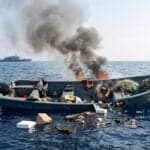


The U.S. military has carried out a new series of strikes on boats in the eastern Pacific Ocean, targeting vessels it says were involved in drug trafficking.
According to updates posted by the U.S. Southern Command on X, the operations were conducted between April 11 and April 14 under Joint Task Force Southern Spear, led by Gen. Francis L. Donovan.
On April 11, U.S. forces struck two vessels operating on known narco-trafficking routes. Officials said intelligence confirmed the boats were linked to designated terrorist organisations and involved in drug trafficking.
Five people described as “narco-terrorists” were killed, while one survived the first strike. The U.S. Coast Guard was notified to begin search and rescue for the survivor.
On April 14, at the direction of #SOUTHCOM commander Gen. Francis L. Donovan, Joint Task Force Southern Spear conducted a lethal kinetic strike on a vessel operated by Designated Terrorist Organizations. Intelligence confirmed the vessel was transiting along known… pic.twitter.com/RH5ldx9tN0
— U.S. Southern Command (@Southcom) April 14, 2026
On April 13, another vessel was struck, killing two people. On April 14, a further strike killed four people. The military said in all three incidents that no U.S. forces were harmed.
The latest round of strikes is part of a campaign that began in early September, targeting suspected drug trafficking boats across the eastern Pacific and other maritime routes in Latin America and the Caribbean.
According to available figures, at least 50 strikes have been conducted since the start of the current administration’s term, destroying 51 vessels and killing around 170 people.
Separate tallies indicate the death toll may have reached as high as 175 following the most recent attacks.
Applying total systemic friction on the cartels. On April 13, at the direction of #SOUTHCOM commander Gen. Francis L. Donovan, Joint Task Force Southern Spear conducted a lethal kinetic strike on a vessel operated by Designated Terrorist Organizations. Intelligence confirmed the… pic.twitter.com/zZQKEPiSoI
— U.S. Southern Command (@Southcom) April 13, 2026
The U.S. Coast Guard has since suspended the search for the survivor from the April 11 strike.
The military has consistently maintained that intelligence confirmed the vessels were engaged in drug trafficking. However, it has not publicly released evidence supporting these claims.
Footage shared by the command shows small boats being struck by aerial munitions and exploding at sea.
The campaign has been backed by Donald Trump, who has stated that the United States is in “armed conflict” with drug cartels in Latin America. He has defended the strikes as necessary to curb drug flows into the United States and reduce overdose deaths.
The strikes began months before a U.S. raid in January that led to the capture of Venezuelan President Nicolás Maduro, who was later taken to New York on drug trafficking charges and has pleaded not guilty.
Applying total systemic friction on the cartels.
On April 11, at the direction of #SOUTHCOM commander Gen. Francis L. Donovan, Joint Task Force Southern Spear conducted two lethal kinetic strikes on two vessels operated by Designated Terrorist Organizations. Intelligence… pic.twitter.com/sRXTFYCWXu
— U.S. Southern Command (@Southcom) April 12, 2026
Despite the scale of the campaign, critics have raised concerns over both legality and effectiveness.
Legal experts have argued that such strikes could amount to extrajudicial killings, noting that international law does not permit deliberate targeting of civilians who do not pose an immediate threat, even if they are suspected of criminal activity.
Others have raised doubts about effectiveness, pointing out that much of the fentanyl linked to overdose deaths enters the U.S. over land through Mexico, not by sea, and is made using chemicals from China and India.
The operations have continued even as the U.S. military has also been focused on tensions in the Middle East involving Iran.
Per reports, the U.S. has discussed plans for a naval blockade affecting Iranian ports, including around the Strait of Hormuz, a key route for global oil shipping.
References: US Southern Command, firstpost
Want to read more?
Check out the full article on the original site