Japan Achieves World’s First Hydrogen-Fueled Marine Engine Operation For Large Commercial Vessel
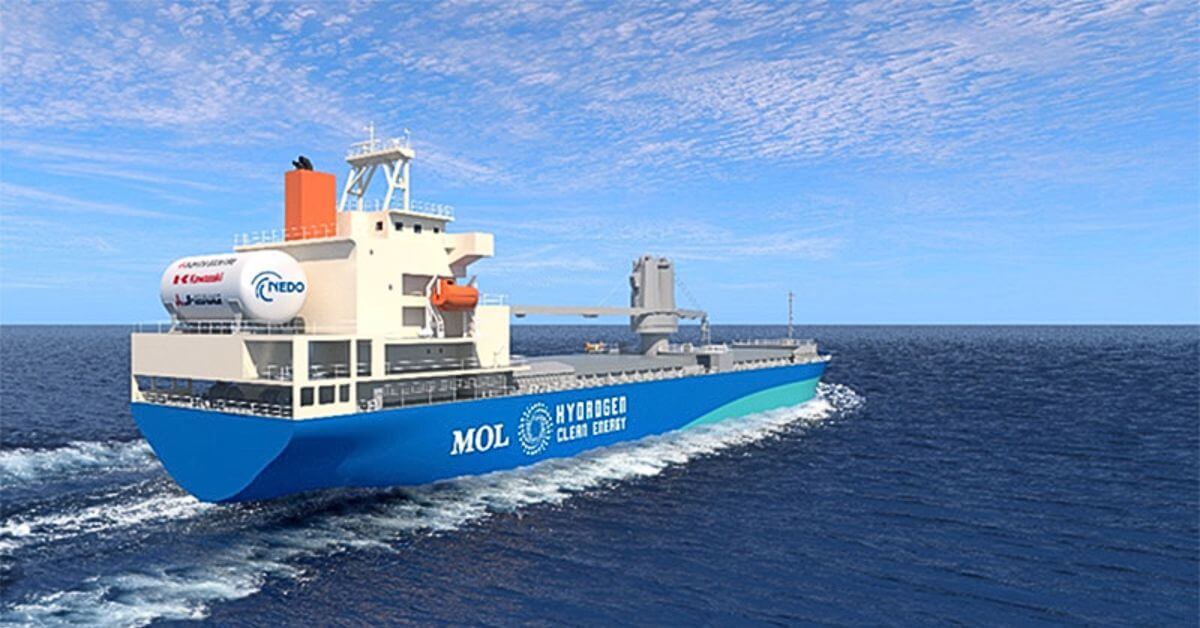
Japan Engine Corporation (“J‑ENG”) and Kawasaki Heavy Industries, Ltd. (“Kawasaki”) are jointly engaged in Green Innovation Fund Project “Development of Marine Hydrogen Engines and MHFS (Note 1)” of the New Energy and Industrial Technology Development Organization (“NEDO”), in cooperation with Mitsui O.S.K. Lines, Ltd. (“MOL”), MOL Drybulk Ltd. (“MOL Drybulk”), Onomichi Dockyard Co., Ltd. (“Onomichi Dockyard”), and Nippon Kaiji Kyokai (“ClassNK”).
Within this project, J‑ENG has been developing a fully Japan-made, large, low‑speed, two‑stroke hydrogen-fueled engine. The world’s first full‑scale engine intended for installation on an actual vessel, 6UEC35LSGH, has successfully begun hydrogen co‑firing operation in all cylinders.
To date, the engine has achieved a hydrogen co‑firing ratio of over 95% at 100% load, confirming both GHG reduction effects and stable operation. Verification testing will continue to further optimize performance under hydrogen co‑firing conditions.
In recent years, the development and demonstration of hydrogen‑fueled vessels have progressed in Japan and abroad. However, most initiatives focus on short‑distance, short‑duration, and low‑output operations-such as sightseeing boats or tugboats using compressed hydrogen-primarily for domestic coastal or port‑area applications.
In contrast, this project combines the high‑efficiency, high‑output, low‑speed two‑stroke hydrogen‑fueled 6UEC35LSGH engine with liquefied hydrogen fuel, thereby enabling long‑distance, long‑duration, and high‑output operations. This represents a major technological milestone toward the practical use of large oceangoing hydrogen‑fueled merchant ships.
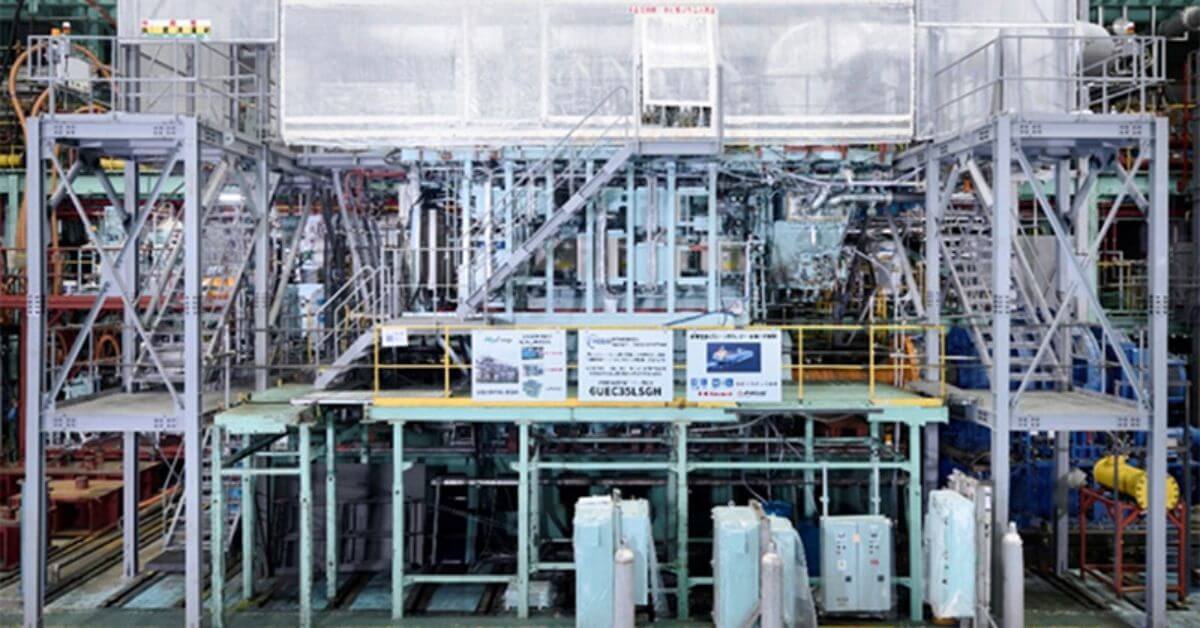
J‑ENG has accumulated expertise through fundamental studies on hydrogen‑related materials and combustion, as well as durability testing of hydrogen fuel injection systems.
The new engine has been developed based on this accumulated knowledge. Once full-scale verification is complete, the engine is scheduled for shipment in January 2027 and will be installed as the main engine of a 17,500‑DWT hydrogen‑fueled multi-purpose vessel (“the Vessel”) designed and built by Onomichi Dockyard.
The MHFS, a hydrogen fuel supply system for this engine, is being developed and manufactured by Kawasaki, and it will also be installed on the Vessel.
MOL and Onomichi Dockyard concluded a series of contracts for the construction of the vessel. In addition, through discussions among the relevant parties, agreements were reached on the specifications of various facilities required for the hydrogen‑fueled vessel, and related contracts were executed. The detailed design of the vessel is currently progressing smoothly.
The Vessel is scheduled to undergo three years of demonstration operation starting in FY2028 under the operation of MOL and MOL Drybulk. Throughout the development of the engine and MHFS, as well as the design, construction, and operation of the vessel, ClassNK will conduct safety evaluations.
With NEDO’s support, J‑ENG and Kawasaki, in collaboration with MOL, MOL Drybulk, Onomichi Dockyard, and ClassNK, will continue taking on the challenge of realizing the practical operation of merchant vessels powered by hydrogen fuel-paving the way toward a sustainable future for the maritime industry.
Press Release
Want to read more?
Check out the full article on the original site