How Humans Migrated Across The Globe Over 200,000 Years: An Animated Look
Our take
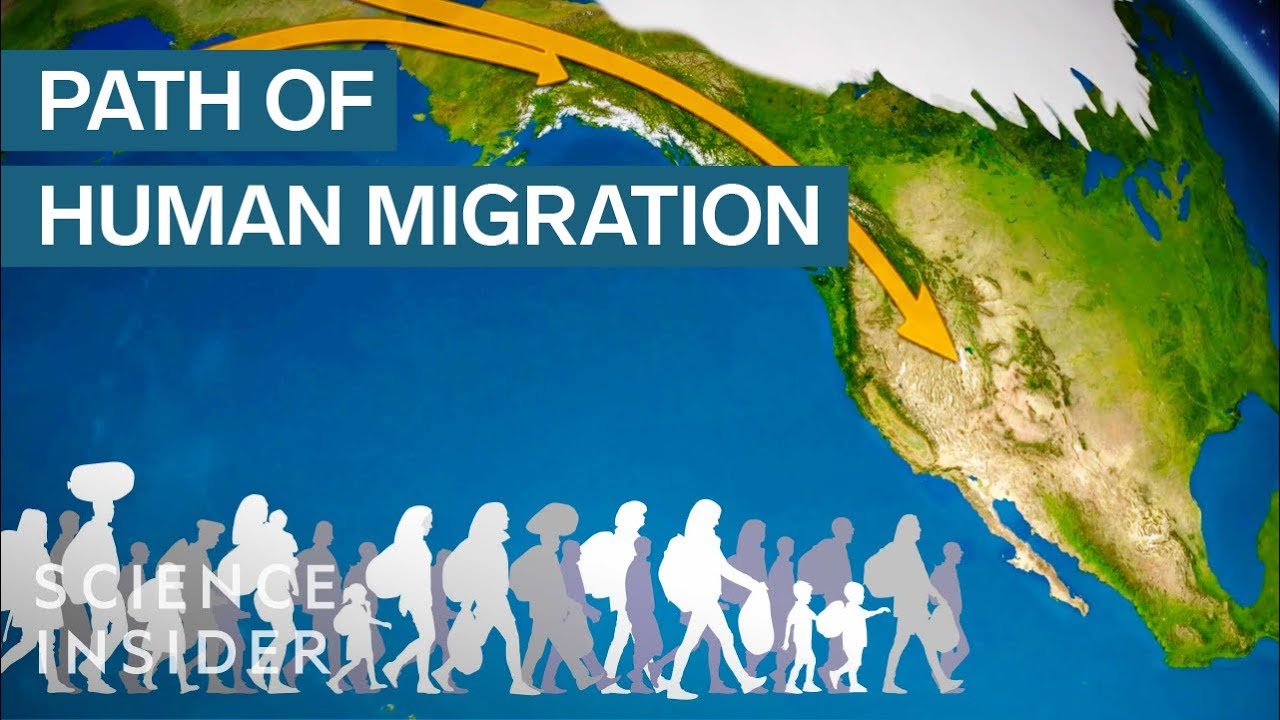
The animation detailing human migration across 200,000 years is, frankly, a beautiful thing. And timely. We’ve been circling the concept of deep time—the almost unfathomable stretches of history that dwarf our modern concerns—in our own corners of the internet, particularly when it comes to language. Consider, for instance, [Hip 1960s Latin Teacher Translated Beatles Songs into Latin for His Students: Read Lyrics for “O Teneum Manum,” “Diei Duri Nox” & More]—a delightful example of how language evolves and adapts, carrying echoes of the past even as it embraces the present. The animation reminds us that *all* of our present-day concerns, political divisions included, are layered upon millennia of movement, adaptation, and, yes, sometimes, displacement. This isn't just about where we *came* from; it’s about understanding the fundamental fluidity of what it means to be human, a fluidity that some voices, amplified during moments like the 2015 refugee crisis, seem determined to deny. It’s a rejection of history itself, a blithe assumption of permanence that is, well, historically inaccurate to say the least. And the University of Bergen’s observations on the media’s framing of the crisis—how easily it becomes a political weapon—are a stark reminder of the stakes involved in understanding this history accurately. What’s truly compelling about this animated look isn't simply the mapping of routes, although that’s fascinating in its own right. It's the way it implicitly challenges our often-rigid notions of belonging. We tend to think of borders as fixed, as natural, as *always* having been there. This animation demonstrates they are, at best, fleeting constructs. The Proto-Germanic root of "shell," as we’ve mused, speaks to the act of hiding, of seeking shelter – a deeply ingrained impulse. And migration, in all its forms, is a manifestation of that impulse. It's a response to climate change, to resource scarcity, to conflict, to the simple human desire for something *more*. To frame it as an invasion, as a threat, is to ignore the millennia of shared experience that bind us, to amputate a fundamental part of what makes us human. It’s an act of willful blindness, a refusal to engage with the long, messy, fascinating tapestry of our collective story. Perhaps a deeper dive into the etymological roots of words like "refugee" and "border" would illuminate this disconnect, a concept we explore in [Q&A weekly thread - June 08, 2026 - post all questions here!]—a space dedicated to linguistic inquiry, because, truly, language holds the keys to understanding so much. The animation’s power also lies in its visual representation of scale. Two hundred thousand years is an almost incomprehensible timeframe. It dwarfs our political cycles, our generational anxieties, even our species’ entire written history. Seeing the ebb and flow of human populations across continents, the gradual spread of *Homo sapiens* from Africa, forces a perspective shift. It reminds us that the current geopolitical landscape is but a fleeting moment in a much longer arc. This isn't to diminish the importance of current events, of course; human suffering is always urgent, always deserving of our attention. But it *is* to suggest that we need to resist the temptation to view these events in isolation, as if they were unconnected to the broader sweep of human history. Learning to appreciate the grand timescale—the way ancient civilizations rose and fell, languages diverged and merged—can foster a sense of humility and interconnectedness. It's a perspective that resonates with the appreciation of ancient narratives like those found in [Hear the First Book of Homer’s Iliad Read Aloud in the Original Greek]—a reminder of the epic stories that have shaped our understanding of ourselves. Ultimately, this animated exploration of human migration is a call for deeper understanding, a challenge to simplistic narratives. It’s a reminder that the story of humanity is one of constant movement, adaptation, and interaction. The question now is: how do we translate this understanding into a more compassionate and equitable world, one that embraces the fluidity of human experience rather than attempting to contain it within artificial boundaries? Will we continue to squirt water on the assumptions that shape our present, or will we allow those assumptions to calcify into walls?
Coverage of the refugee crisis peaked in 2015. By the end of the year, note researchers at the University of Bergen, “this was one of the hottest topics, not only for politicians, but for participants in the public debate,” including far-right xenophobes given megaphones. Whatever their intent, Daniel Trilling argues at The Guardian, the explosion of refugee stories had the effect of framing “these newly arrived people as others, people from ‘over there,’ who had little to do with Europe itself and were strangers.”
Such a characterization ignores the crucial context of Europe’s presence in nearly every part of the world over the past several centuries. And it frames mass migration as extraordinary, not the norm. The crisis aspect is real, the result of dangerously accelerated movement of capital and climate change. But mass movements of people seeking better conditions, safety, opportunity, etc. may be the oldest and most common feature of human history, as the Science Insider video shows above.
The yellow arrows that fly across the globe in the dramatic animation make it seem like early humans moved by bullet train. But when consequential shifts in climate occurred at a glacial pace—and economies were built on what people carried on their backs—mass migrations happened over the span of thousands of years. Yet they happened continuously throughout the last 200,000 to 70,000 years of human history, give or take. We may never know what drove so many of our distant ancestors to spread around the world.
But how can we know what routes they took to get there? “Thanks to the amazing work of anthropologists and paleontologists like those working on National Geographic’s Genographic Project,” Science Insider explains, “we can begin to piece together the story of our ancestors.” The Genographic Project was launched by National Geographic in 2005, “in collaboration with scientists and universities around the world.” Since then, it has collected the genetic data of over 1 million people, “with a goal of revealing patterns of human migration.”
The project assures us it is “anonymous, nonmedical, and nonprofit.” Participants submitted their own DNA with National Geographic’s “Geno” ancestry kits (and may still do so until next month). They can receive a “deep ancestry” report and customized migration map; and they can learn how closely they are related to “historical geniuses,” a category that, for some reason, includes Jesse James.
Do projects like these veer close to recreating the “race science” of previous centuries? Are they valid ways of reconstructing the “human story” of ancestry, as National Geographic puts it? Critics like science journalist Angela Saini are skeptical. “DNA testing cannot tell you that,” she says in an interview on NPR, but it can “make us believe that identity is biological, when identity is cultural.” National Geographic seems to disavow associations between genetics and race, writing, “science defines you by your DNA, society defines you by the color of your skin.” But it does so at the end of a video about a group of people bonding over their similar features.
Despite the significance modern humans have ascribed to variations in phenotype, race is a culturally defined category and not a scientific one, argues Joseph L. Graves, professor of biological sciences at the Joint School of Nanoscience and Nanoengineering. “Everything we know about our genetics has proven that we are far more alike than we are different. If more people understood that, it would be easier to debunk the myth that people of a certain race are ‘naturally’ one way or another,” or that refugees and asylum seekers are dangerous others instead of just like every other human who has moved around the world over the last 200,000 years.
Note: An earlier version of this post appeared on our site in 2019.
Related Content:
Colorful Animation Visualizes 200 Years of Immigration to the U.S. (1820-Present)
Where Did Human Beings Come From? 7 Million Years of Human Evolution Visualized in Six Minutes
Watch Animations Showing How Humans Migrated Across the World Over the Past 60,000 Years
Josh Jones is a writer and musician based in Durham, NC.
Read on the original site
Open the publisher's page for the full experience